
From the Battlefield to California's Front Lines: Lee Palmer’s Lifelong Mission of Service and Safety
Get to Know Us

It may be surprising that a veteran of conflict in the Middle East faced the biggest challenge of his career after working for the California Public Utilities Commission (CPUC) for only two years.
Lee Palmer, an Army and Army National Guard veteran, served as an officer in Iraq, Kuwait, and Afghanistan. He also deployed several times to fight wildfires and other emergencies across California.
Then, he served as the CPUC’s chief negotiator for the deadly Camp Fire.
The Camp Fire in northern California’s Butte County burned through the town of Paradise and caused 85 fatalities and destroyed over 18,000 structures, the deadliest and most destructive wildfire in California history. The investigation and subsequent settlement with Pacific Gas and Electric Company (PG&E) represent the largest action the CPUC has ever undertaken, and the largest penalty enacted on a utility anywhere to date.
Palmer, the CPUC’s Director of the Safety and Enforcement Division (SED) at the time (currently Deputy Executive Director for Safety Enforcement, Safety Policy, and Water), went on many long walks to clear his head.
“That was the hardest time period in my career,” he says. “The investigation had to be independent and objective, and it rightfully felt very isolating at the time. I got many steps in mulling things over in my mind and remembering why I was doing this work, for the people there, who lost so much.”
Palmer oversaw the CPUC’s investigation that documented numerous regulatory violations by PG&E and negotiated a historic enforcement penalty settlement of $2.137 billion.
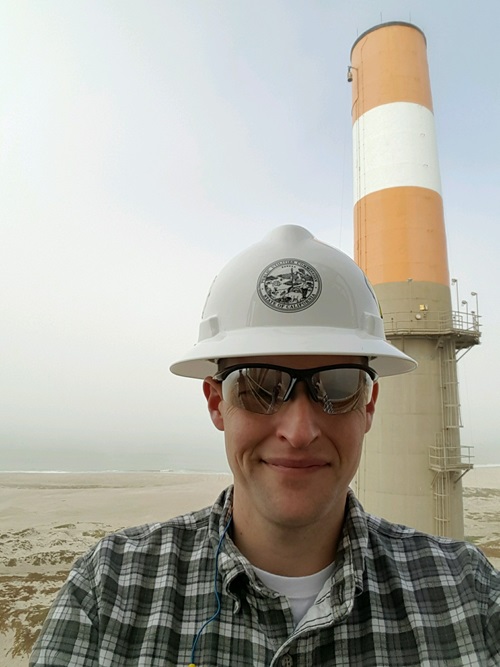
Palmer at an audit of Mandalay Generating Station in 2017.
A Life of Service
Palmer may have known a little of what he was getting into while growing up in Walnut Creek, Calif. His parents worked as nurses and his father is a Vietnam veteran who also served in the Army National Guard, responding to wildfires and other emergencies throughout his career. Palmer was active in Scouts, spent much time outside and doing community service with his family, and he learned military tradition and values from his father. When it came time to attend the University of California, Davis, he took on a dual track of college courses and joining ROTC.
“I decided I was going to join the Army and help people that need help, whether it’s food, clean water or medical supplies,” he says. “Plus, money was tight and this was a way to pay for school.”
When Palmer graduated from college in 2002, he packed all he owned into his pickup and headed to Fort Bliss, El Paso, Texas, his duty station for the next four years. He trained as an Air Defense Artillery Officer and was soon deployed to Kuwait and Iraq. There, he served as a Platoon Leader in charge of 48 Soldiers with a mission to shoot down SCUD missiles and enemy aircraft in what became the Iraq War. He was 23 years old.
Palmer says the next few years blur in his mind. He was deployed for the initial invasion of Iraq, then deployed again in 2005 to help train Kuwaiti forces to defend themselves. During this time, he learned some of his most important leadership lessons he still relies on today.
“Don’t be afraid to ask questions, even when the temperature is turned up,” he says. “You only look stupid if you act like you know something you don’t. Rely on your Soldiers and take care of them. Find a mentor you can trust.”
In 2006, Palmer left active duty. He moved to Chicago and took a corporate job he ended up finding unfulfilling. In 2009, he was back as a Civil Support Planner for the California Military Department, a post that required he also re-enlist in the Army National Guard.
He remembers standing in line for his Army physical before serving as a Captain, almost 30 years old and a combat veteran. The doctor checking recruits in tried to talk him out of re-joining since there was a surge in military action and high casualties.
“This is where I can be most useful,” Palmer decided at the time. “Sometimes you need to run toward the issue.”
From there, Palmer lived two parallel lives. He served as a Civil Support Planner and a Logistics Officer working closely with CAL FIRE and the California Governor’s Office of Emergency Services to respond to national disasters, civil unrest, and wildfires. (He built a network of colleagues he still works with today.) And he served as an officer in the Army National Guard holding numerous positions, including Battalion Commander of a logistics unit with 800 soldiers. He was deployed to Afghanistan in 2013 and served as the Chief of Sustainment for a unit with over 2,000 soldiers and a mission to close down bases.
“I’ve watched people fight over water, milk, a bag of Skittles,” he says. “I’ve seen people starving and I’ve seen society break down in 20 minutes. Where there’s military action, there’s also people’s homes. At the end of the day, most people just want to safely walk their kid to school, and lead a happy, healthy life. That’s the kind of world I want to live in too.”
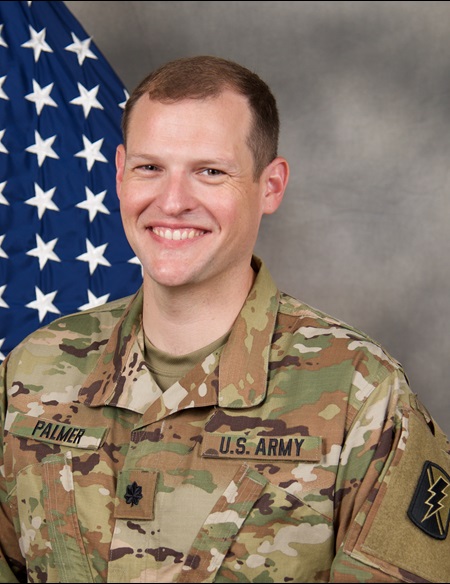
Command Photo of Lieutenant Colonel Palmer, Battalion Commander of the 40th Brigade Support Battalion in 2018.
A Mission of Safety at the CPUC
Palmer joined the CPUC as the Deputy Director of SED in 2016 and was promoted to Director in 2019. He didn’t retire from the Army National Guard until 2022. Somewhere in there, he also finished his Master of Business Administration from St. Mary’s College and started a family, a son who is now 12 years old and enjoys Scouts and the outdoors as much as his father.
While his CPUC work doesn’t include being deployed to war-torn countries, the work is an extension of his previous career planning for and handling emergencies and problem-solving for a better future in the aftermath.
SED oversees the safety of all energy and communications facilities that the CPUC regulates across California, from electric, natural gas, and propane infrastructure to power generation and energy storage systems. The Division performs safety audits, investigations, and issues penalties as well as oversees utility Public Safety Power Shutoffs and coordinates with other state agencies on wildfires and emergencies.
“When something comes to SED, it’s usually not good news, a community’s power is shut off or a wildfire is moving quickly,” Palmer says. “Like the military, you have to enable and trust your staff. You first make sure everyone is okay, then you get the facts, you communicate, and you start working on solutions together. Mission first. People always.”
Palmer’s motto is right in line with how others see him.
“Lee is a selfless leader who takes responsibility, is fiercely loyal to his team, and has an unwavering commitment to getting better each day,” says Forest Kaser, Director of the California Office of Energy Infrastructure Safety, and previously Palmer’s supervisor at the CPUC. “He’s also a selfless person, always willing to put others first and to lend a helping hand.”
Palmer became the Deputy Executive Director for Safety Enforcement, Safety Policy, and Water a year ago, now leading others in handling emergency situations and stretching his career to include the CPUC’s oversight of water utilities across California.
“Lee wants to see all the aspects of the work we do,” says Jason McMillan, CPUC Senior Utilities Engineer for Natural Gas Safety and Reliability. “He joined me on a few natural gas safety inspections when I was a new supervisor. We talked a lot about service, stewardship, and leadership. He has a sincere love for the work we do and doesn’t let even a mote of cynicism seep in. It’s something I admire and try to emulate.”
Palmer says he never feels like the smartest person in the room. “I’m surrounded by well-credentialed experts, engineers, and lawyers, and it drives me to want to learn more.”
It seems Palmer has spent a career to-date learning in real-time, whether it’s figuring out logistics to support an entire Afghani province with food, water, medical supplies, and ammunition, or thinking through the largest wildfire investigation and settlement in California history during all those long walks. All of this with the hope that more lives will be saved in the future.
And he’s definitely done yet.
“I’m excited to be here and in this newer role,” he says. “I look forward to focusing and spending time with my staff in the field. It’s a good team and a good place. I can’t imagine working anywhere else.”
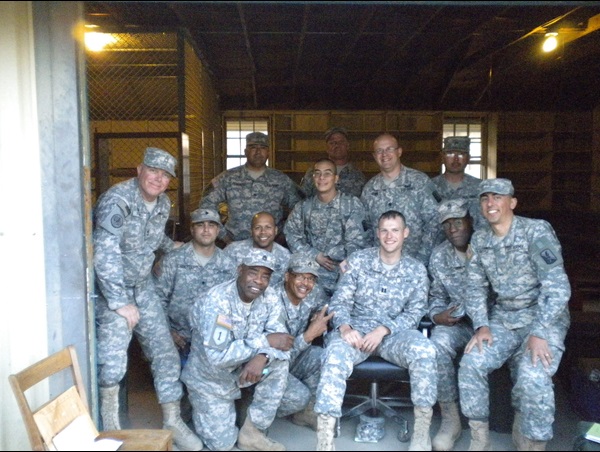
Captain Palmer, Company Commander of Golf Company, 40th BSB, with his command team at Camp Roberts in 2011.
By Jody Holzworth, Deputy Executive Director, External Affairs Division