
The Chumash Fiber Network
The fiber optic technology behind the Santa Ynez Chumash’s tribally owned broadband network in Santa Barbara County, California

When the Santa Ynez Band of Chumash Indians set out to develop a broadband network to improve their community’s resiliency and quality of life, they faced the familiar challenge of delivering reliable, high-speed internet service across diverse terrain prone to wildfires. Their solution is a tribally owned network using 10 Gigabit Symmetrical Passive Optical Network (XGS-PON).
With a broadband infrastructure grant from the California Public Utilities Commission’s (CPUC) Federal Funding Account, the Santa Ynez Chumash are building a resilient high-capacity underground fiber optic network that will offer up to five gigabits per second (Gbps) symmetrical service to residents within Chumash Tribal Lands and benefit the surrounding population.
The Chumash Fiber Network spans roughly 13 miles of underground fiber through more than 1,400 acres of ranch land where tribal housing is being developed, known as Camp 4, to the original Chumash Reservation where the network equipment data center is housed at the Chumash Casino Resort.
The project leverages California's open-access Middle Mile Broadband Initiative (MMBI) to upgrade existing backhaul infrastructure and support the new network traffic.
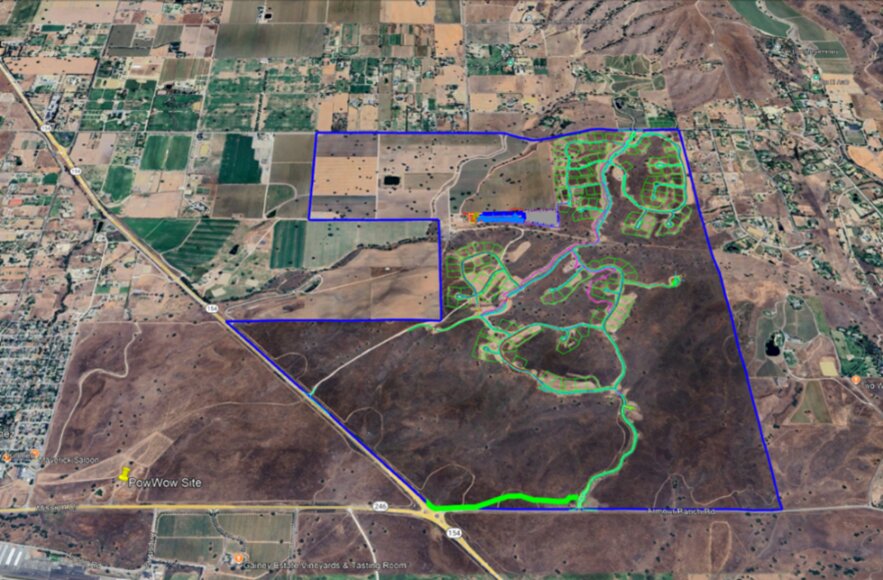
Camp 4 development with blue tribal land boundaries.
Why PON Technology?
Passive Optical Network (PON) technology is efficient, scalable, and cost-effective for meeting current and future demand for broadband connectivity. The "passive" designation means that the network uses unpowered (passive) optical splitters to distribute light signals from a single fiber strand to multiple endpoints. This engineering choice eliminates the need for electrical equipment between the central network hub and customer locations, reducing infrastructure costs and potential points of failure.
For the Chumash Broadband Network, this approach has multiple benefits. By minimizing active components in the field, the system requires less maintenance and consumes less power.
As the Chumash Project Manager, David Fein, explained, “The obvious choice was XGS-PON. Today it is XGS, and already they are testing to 10, 25, and even 50 gigabit PON. So that same 10 Gbps service will be able to be expanded to 25 and to 50, easily, over the next 20 years or so. This will enable our service to continue for the next few generations. This technology was the only way to fit the requirement – we had to bury the fiber, and we wanted it to be resilient, robust, and redundant.”
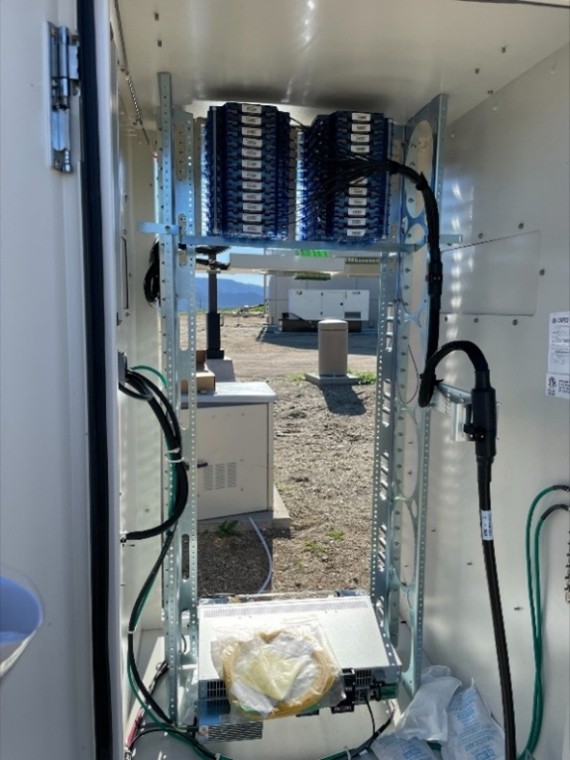
Fiber cabinet for scalable passive distribution panels, eliminating the need for electrical equipment.
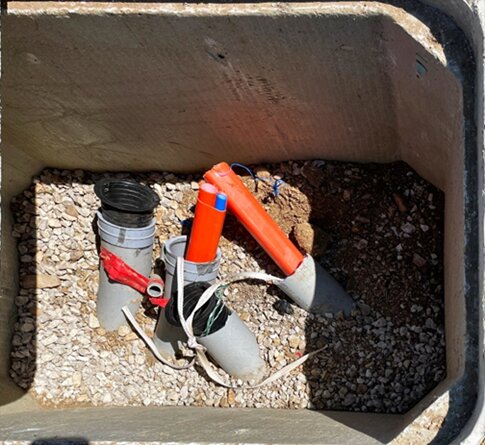
Vault with pulled conduit is ready for PON technology and easily upgraded.
How XGS-PON Works
The Chumash network operates on XGS-PON, a fiber optic standard capable of transmitting data at 10 gigabits per second (Gbps) in both directions. This symmetrical service generally distinguishes fiber from other residential broadband technologies, such as cable and satellite, which typically provide faster download speeds than upload speeds.
The network centers around an Optical Line Terminal (OLT) located at Tribal Data Center. The OLT functions as the network's brain managing traffic and communication with individual subscribers. From this central point, fiber optic cables extend outward through passive optical splitters that divide the light signal, and thus the available bandwidth, among multiple paths. Each customer location receives an Optical Network Terminal (ONT), a small box that converts optical signals back into electrical data that computers and other devices can process.
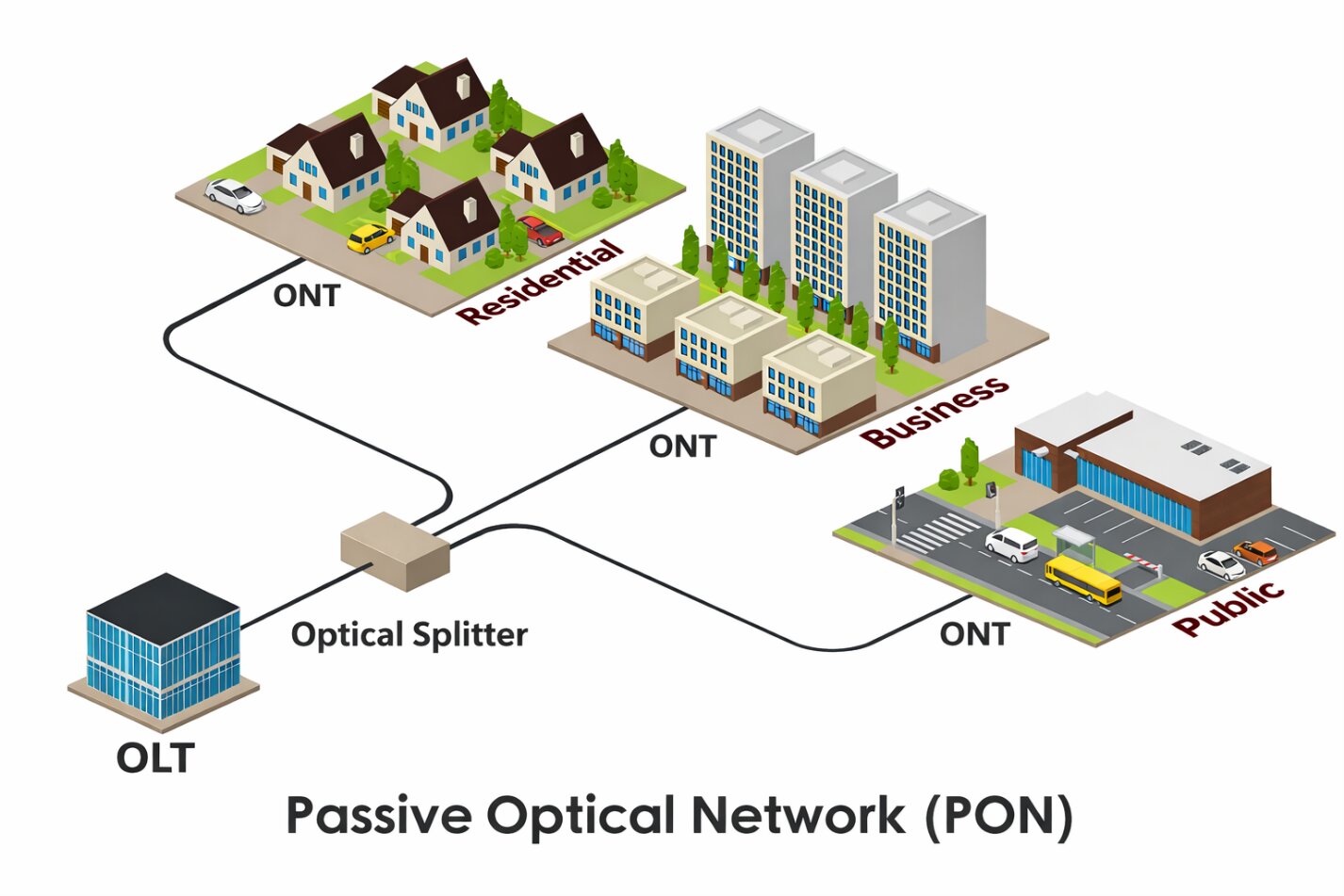
Underground for Resilience
Resiliency is the clear priority for the Chumash broadband network, particularly regarding wildfires and other environmental conditions in the Santa Ynez area. Aerial fiber installations, common for many deployments due to lower upfront costs, remain vulnerable to weather events, falling trees, and vehicle strikes. Exposed infrastructure becomes a liability in areas where wildfires present ongoing threats.
Underground installation presented its own challenges. The Santa Ynez Chumash lands hold cultural significance and require careful protocols for any construction that might disturb ancestral sites. Mapping from existing utilities was incomplete, and so the Chumash needed to perform extensive surveys before boring could begin. Most of the underground installation used horizontal boring, which reduces ground disturbance compared with trenching. The tribe committed to this approach specifically for its durability.
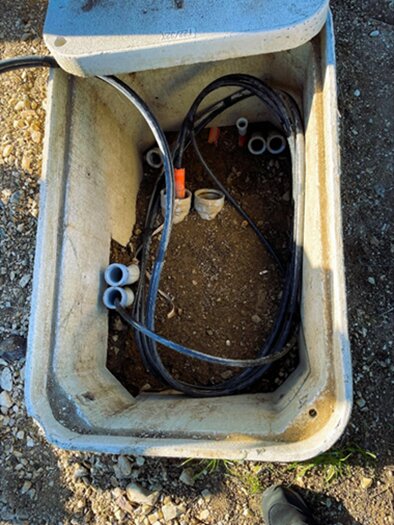
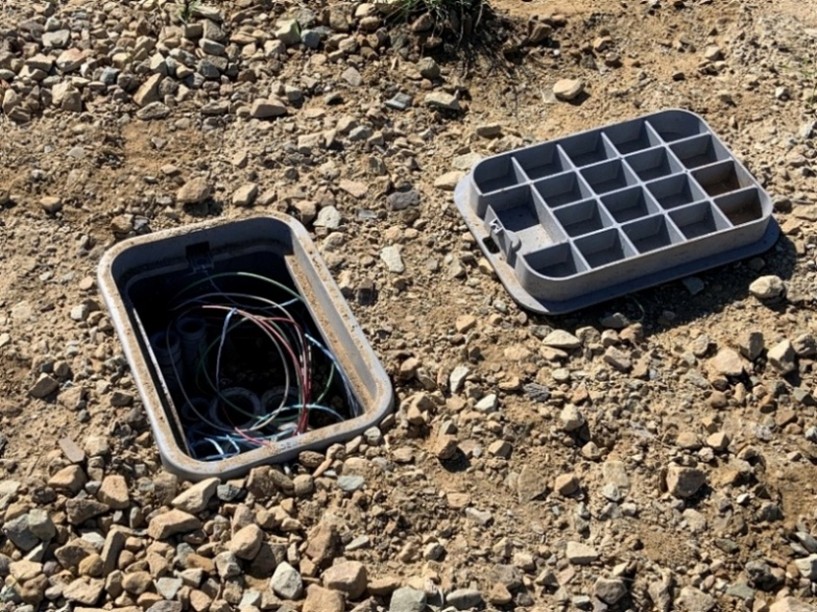
Underground fiber vaults protect critical network infrastructure from weather and accidental damage, improving long-term reliability and reducing service disruptions.
Understanding Symmetrical Gigabit Service
Symmetrical bandwidth is becoming a necessity for modern internet users, and it also represents a paradigm shift. Legacy cable and copper digital subscriber line (DSL) connections were engineered on the assumption that users primarily consume content, downloading web pages and streaming video, rather than producing it, which requires robust upload speeds.
The Chumash network's high-capacity symmetrical service eliminates the upload constraints. Users will be able to simultaneously produce and stream content across multiple devices, participate in video conferences, attend online classes and telehealth appointments, back up files to cloud storage, and access home security feeds remotely.
“If you are streaming your entertainment and working from home, with kids on the internet, you are limited. Gigabit service is the only way to guarantee we have bandwidth for today and tomorrow. Every time you turn around it's another device in your home. Cameras, TVs, tablets, PCs, phones - everything. They are all putting a capacity burden on your connection because the data is being backed up in the cloud,” said Fein.
For tribal members operating businesses from home or for educational institutions requiring reliable video connectivity, this capability transforms what's possible.
Network Capacity
The Chumash network will initially operate at a fraction of its multi-gigabit design capacity, offering customers symmetrical gigabit service that exceeds typical consumer needs today, with ample room for expansion without infrastructure upgrades. This conservative capacity planning reflects industry best practices and can accommodate future upgrades to 25GS-PON technology, which would increase throughput to 25 Gbps, simply by replacing the interface equipment while retaining the existing fiber infrastructure.
Further Reading
- Thinking in Generations: The Santa Ynez Chumash Path to Resilience
- Chumash Fiber Network Map
- Last Mile Federal Funding Account Grant Program
- Broadband Development Resources
By Michele King (Sr. Policy Analyst) with the CPUC’s Broadband Regional Initiatives team